7 July 2026
The Contradictions of Men in Tech: Inclusion, Bias, and Culture
One cannot claim exclusion while actively creating it for others. Men in tech do not need to feel threatened by women's advancement. But they do need to confront the contradiction between claiming exclusion and actively practicing it, and to interrogate the patriarchal assumptions many of them were taught long before they ever opened a laptop. True innovation requires intellectual humility. It requires the courage to debug not only code, but culture.
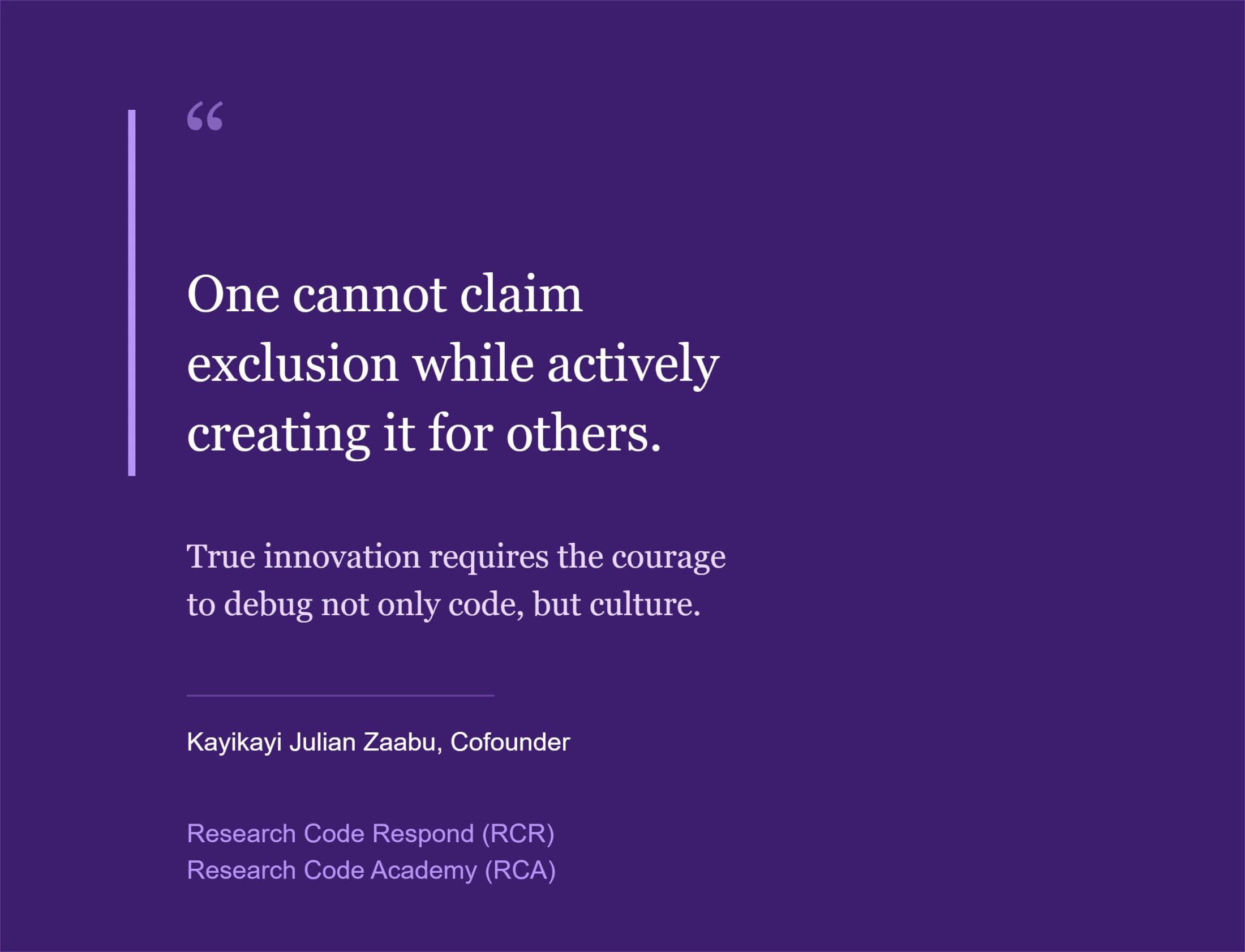
There is a growing narrative among some men in tech that they feel “left out” of women-in-tech movements. They argue that inclusion efforts have become exclusionary, that opportunities are now biased, and that merit is being replaced by gender politics. Yet, in many workplaces, these same men are the first to undermine women’s presence in technical spaces. It is not uncommon for a woman to join a tech team and, before she has written a single line of code or contributed to a sprint, be told to her face: “For you, you know nothing,” or “I think it’s a mistake that you’re on this team.” Others go further, suggesting she was only added to make the organization appear gender-sensitive. These judgments are made without any evaluation of competence, discipline, or performance. The verdict is delivered at introduction.This is where the hypocrisy lies. One cannot claim exclusion while actively creating it for others. To understand this behavior, we must also look beyond the office walls. Many of these attitudes do not originate in tech spaces; they are imported into them. Some men are socialized in deeply patriarchal communities where they are taught explicitly or subtly that men are naturally more intelligent, more logical, and more suited for technical work than women. These beliefs are rarely interrogated. Instead, they are carried into professional environments with confidence and audacity. When such men enter tech teams, they do not see women as colleagues to collaborate with; they see them as anomalies to question. The workplace then becomes a stage where long-held social hierarchies are replayed.
Usually the comments to women in tech are often dismissed as jokes, blunt honesty, or “just how tech culture is.” But their impact is far from harmless. They contribute directly to workplace dissatisfaction, silence women during technical discussions, and intensify imposter syndrome. When someone is constantly told explicitly or subtly that they do not belong, even the most capable professional begins to question themselves. The situation becomes more troubling when leadership reflects the same bias. In environments led by managers who normalize sexist thinking, women who report misogynistic remarks are labeled as emotional, weak, or unprofessional. Instead of addressing the toxic behavior, institutions sometimes pathologize the reaction to it. This not only discourages reporting but normalizes discrimination under the guise of protecting productivity or maintaining “strong” technical culture. Tech prides itself on logic, innovation, and problem-solving. Yet many tech spaces fail to apply that same analytical rigor to their own social structures. Meritocracy cannot exist where assumptions precede evidence. You cannot evaluate performance fairly if you have already decided someone is incompetent based on gender. At the same time, change cannot stop at calling out individuals. The system itself must shift. Employers must move beyond tokenistic inclusion, adding women to teams simply to meet gender balance targets or improve public image. Representation without structural transformation often places women into environments that remain hostile, competitive in exclusionary ways, or informally networked around male dominance. Hiring women into unchanged systems does not produce inclusion; it often reproduces isolation. True change requires transforming organizational culture and the way work is structured. How are meetings facilitated? Whose ideas are validated? How is feedback delivered? How are promotions decided? Are there clear accountability mechanisms for discriminatory behavior? Inclusion must be embedded in the processes of work, not merely in recruitment statistics. As a social worker exploring digital social work and interdisciplinary collaboration with developers, I have come to understand that technology is not just about systems and code. It is about power, access, voice, and culture. The culture of a team determines who feels confident to contribute, who advances, and who quietly exits the field. If institutions can teach algorithms, artificial intelligence, and cybersecurity, they can also teach gender studies, workplace ethics, and power dynamics. Technical training without social awareness produces technically skilled professionals who may unknowingly perpetuate harmful environments. Interdisciplinary education is not a distraction from tech excellence; it is essential to sustaining it. But training alone is insufficient if organizational systems remain unchanged. Inclusion is not a favor to women. It is not charity. It is not branding. It is a necessary correction to systemic imbalance. And it demands more than hiring numbers. It requires cultural transformation, structural accountability, and a willingness to unlearn inherited beliefs about intelligence and gender. Men in tech do not need to feel threatened by women’s advancement. But they do need to confront the contradiction between claiming exclusion and actively practicing it and to interrogate the patriarchal assumptions many of them were taught long before they ever opened a laptop. True innovation requires intellectual humility. It requires the courage to debug not only code, but culture. And perhaps the real disruption tech needs is not just technological but systemic.